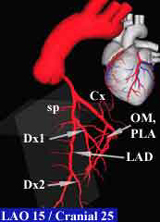
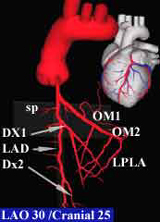
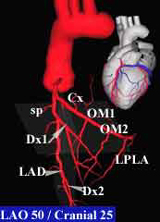
When
you have completed review of this screen, please click the "Next page"
blue arrow for the second portion of this section. When
you have completed review of this screen, please click the "Next page"
blue arrow for the second portion of this section.
A
shallow RAO (10 to 20 degrees) with a 15 to 30 degrees cranial angulation
is an excellent view that:
- lays out the left main coronary artery
- lays out the proximal left anterior descending
- projects the origin and trunks of the ramus
intermediate and first diagonal downwards to avoid overlap
by the proximal circumflex
In the Right Anterior Oblique or RAO-Cranial view, the
camera is rotated along a vertical axis towards the patient's right
and also along the vertical axis towards the head or cranium, as shown
in the bottom-left picture. The camera and image intensifier are represented
by the arrowhead (cone) while the source of the x-ray beam is demonstrated
by the tail of the arrow (cylinder). The shaft of the arrow is the
x-ray beam as it travels through the heart and across the right and
left coronary arteries. Please note that the ventricular septum lies
in a plane between the right shoulder and the left nipple. Thus, in
the RAO view, the camera "looks" at the outline of the septum, but
from a point of view that is higher than the straight RAO view. than
the straight RAO view. |