The
aortic valve has three leaflets, each having a cusp or cup-like configuration.
These are known as the left coronary (LC), right coronary (RC) and the
posterior non-coronary (NC) cusps. The latter is called a non-coronary
cusp because a coronary artery artery does not commonly originate from
this cusp. The left coronary artery arises from the left coronary cusp
and the the right coronary artery arises from the right coronary cusp.
The left coronary artery usually divides into two branches, known as
the left anterior descending (LAD) and the circumflex
(Cx) coronary arteries. In some patients, a third branch arises in between
the LAD and the Cx. This is known as the ramus, intermediate (Int),
or optional diagonal coronary artery. The LAD travels in the anterior
inter-ventricular groove that separates the right and the left ventricle,
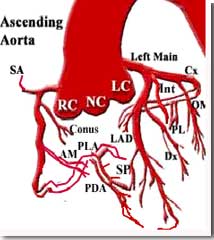
in the front of the heart. The figure on the top left demonstrates what
the coronary arteries look like in the antero-posterior or AP view.
The diagonal (Dx) branch comes off the LAD and runs
diagonally across the anterior wall towards its outer or lateral portion.
Thus, the Dx supplies blood to the antero-lateral portion of the left
ventricle. A patient may have one or several Dx branches. The first
Dx branch serves as the boundary between the proximal
and mid portion of the LAD. Thus, the portion of the artery
prior to the origin of the Dx is known as the proximal
LAD, while the segment just below the Dx is the mid LAD.
The distal segment of the LAD is the terminal
third of the artery.
The
septal perforators are the other branches of the LAD and supplies
blood to the septum of the left ventricle.
Thus, the LAD travels in the
anterior inter ventricular (AIV) groove which runs in front of the
heart, between the right and left ventricles. The
Dx or diagonal is a branch of the LAD that runs diagonally away from
the AIV groove and towards the antero-lateral portion of the heart.
The
septal perforators (SP) runs into the septum and provides its blood
supply.

The aortic valve has three leaflets, each having a cusp
or cup-like configuration. These are known as the left coronary (LC),
right coronary (RC) and the posterior non-coronary (NC) cusps. The latter
is called a non-coronary cusp because a coronary artery artery does
not commonly originate from this cusp. The left coronary artery arises
from the left coronary cusp and the the right coronary artery arises
from the right coronary cusp.
The left coronary artery usually divides into two branches, known as
the left anterior descending (LAD) and the circumflex (Cx) coronary
arteries. In some patients, a third branch arises in between the LAD
and the Cx. This is known as the ramus, intermediate (Int), or
optional diagonal coronary artery.
The LAD travels in the anterior inter-ventricular groove that
separates the right and the left ventricle, in the front of the heart.
The figure on the top left demonstrates what the coronary arteries look
like in the antero-posterior or AP view.
The diagonal (Dx) branch comes off the LAD and runs diagonally
across the anterior wall towards its outer or lateral portion. Thus,
the Dx supplies blood to the antero-lateral portion of the left ventricle.
A patient may have one or several Dx branches. The first Dx branch serves
as the boundary between the proximal and mid
portion of the LAD. Thus, the portion of the artery prior to the origin
of the Dx is known as the proximal LAD, while the segment
just below the Dx is the mid LAD.
The distal segment of the
LAD is the terminal third of the artery. The septal perforators are
the other branches of the LAD and supplies blood to the septum of the
left ventricle.
Thus, the LAD travels in the
anterior inter ventricular (AIV) groove which runs in front of the heart,
between the right and left ventricles. The
Dx or diagonal is a branch of the LAD that runs diagonally away from the
AIV groove and towards the antero-lateral portion of the heart. The
septal perforators (SP) runs into the septum and provides its blood supply.